Introduction
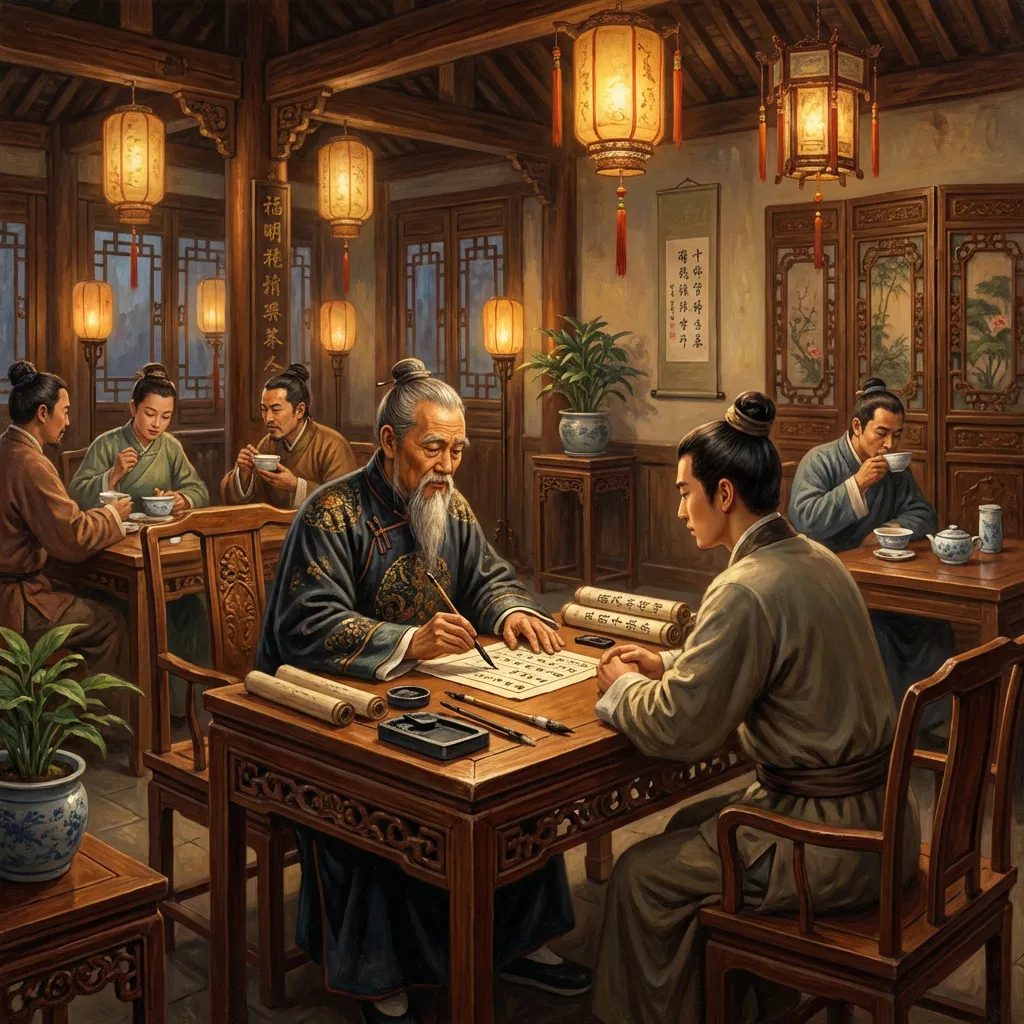
Chinese astrology is one of the oldest continuously practiced divination systems in the world, with a documented history spanning over 3,000 years. Unlike Western astrology, which centers on the positions of celestial bodies along the ecliptic, Chinese astrology is rooted in cyclical time — the rhythmic interplay of the Heavenly Stems and Earthly Branches, the Five Elements, and the cosmic dance of Yin and Yang.
What we now call Bazi (八字) — the Four Pillars of Destiny — is the culmination of millennia of observation, philosophical development, and refinement by scholars and masters across every major Chinese dynasty. Its story is inseparable from the story of Chinese civilization itself.
To understand Bazi is to understand how the Chinese have, for thousands of years, sought to harmonize human life with the rhythms of heaven and earth. It is a tradition born from humility before the cosmos and sharpened by centuries of meticulous observation.
Ancient Origins: The Shang Dynasty (1600 - 1046 BCE)
The earliest roots of Chinese astrology can be traced to the Shang Dynasty, where diviners carved questions into oracle bones (甲骨 — jiagu) — typically the shoulder blades of oxen or the plastrons of turtle shells. These bones were heated until they cracked, and the patterns were interpreted as messages from the spirit world.
It was during this period that the Heavenly Stems (天干) and Earthly Branches (地支) system was first developed. The ten Heavenly Stems and twelve Earthly Branches were used to mark days in a 60-day cycle — the same sexagenary (60-unit) cycle that would later become the backbone of Bazi calculation.
Key Developments
- •Oracle bone inscriptions — the first recorded attempts to divine heavenly patterns and understand cosmic will
- •Development of the sexagenary cycle using Heavenly Stems and Earthly Branches for day-counting
- •Emergence of the concept that celestial patterns influence human affairs — the philosophical seed of all Chinese astrology
- •Astronomical observation and record-keeping that would inform later astrological systems
Han Dynasty Development (206 BCE - 220 CE)
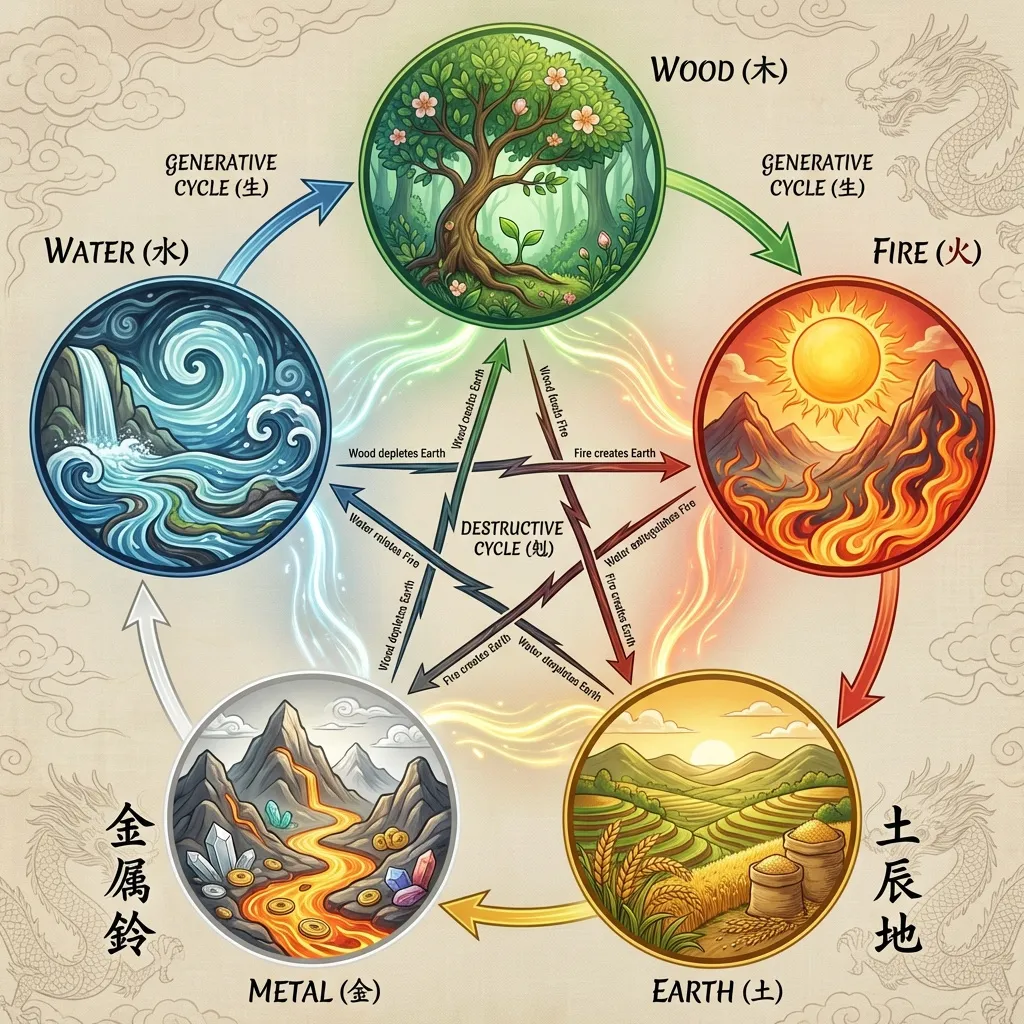
The Han Dynasty was a golden age of intellectual synthesis. It was during this period that the Five Elements theory (五行 — Wuxing) was formalized and integrated into astrological practice. The five elements — Wood, Fire, Earth, Metal, and Water — were understood not as physical substances but as phases of transformation, each with its own character and relational dynamics.
Han scholars wove together the Heavenly Stems, Earthly Branches, Five Elements, Yin-Yang philosophy, and the I Ching (易经) into a coherent cosmological framework. The Chinese calendar system was refined, and the first proto-Bazi calculations emerged — early attempts to use a person's birth data to analyze destiny.
Philosophical Foundations
The Han Dynasty saw the formalization of correlative cosmology — the idea that everything in the universe is interconnected through resonance. Humans, as microcosms of the universe, carry the same elemental patterns found in nature. This philosophical framework gave Bazi its theoretical backbone: your birth chart is a snapshot of the universe's state at the moment you entered it.
Practical Advances
- •Formalization of the Five Elements and their cycles
- •Integration with I Ching divination methods
- •Refinement of the Chinese lunisolar calendar
- •First attempts at birth-data-based destiny analysis
Tang Dynasty Golden Age (618 - 907 CE)
The Tang Dynasty marks the birth of Bazi as a formalized discipline. The pivotal figure of this era was Li Xuzhong (李虚中), a scholar-official widely regarded as the "Father of Bazi." Li developed a systematic method for analyzing a person's destiny based on three pillars: the Year, Month, and Day of birth.
Under Li Xuzhong's three-pillar system, practitioners could derive six characters from a person's birth data and use them to assess personality, fortune, and life trajectory. His work elevated destiny analysis from folk divination to a respected intellectual pursuit, and it quickly found its way into the imperial court.
Li Xuzhong: The Father of Bazi
Li Xuzhong served as an official during the Tang Dynasty and was renowned for his accuracy in predicting people's fortunes based on their birth data. The great literary figure Han Yu (韩愈) wrote Li's epitaph, praising his ability to deduce a person's wealth, status, and lifespan from their birth characters.
His three-pillar method used only the Year, Month, and Day — the Hour Pillar would not be added for another few centuries. Despite this limitation, his system was remarkably effective and laid the groundwork for everything that followed.
During the Tang Dynasty, astrology became an important tool for imperial governance. Court astrologers advised emperors on auspicious dates for ceremonies, military campaigns, and administrative decisions. The cultural prestige of the Tang court helped spread astrological knowledge throughout East Asia.
Song Dynasty Refinement (960 - 1279 CE)
The Song Dynasty brought the most transformative advancement in Bazi history: the addition of the Hour Pillar. The master responsible was Xu Ziping (徐子平), whose innovation expanded the system from six characters to the eight we use today — completing the 八字 (Eight Characters) framework.
Xu Ziping also shifted the primary reference point from the Year Pillar to the Day Pillar, establishing the Day Master (日主) as the core of identity. This was a revolutionary change: rather than defining people primarily by their birth year (as the zodiac system does), the Ziping method recognized the Day Stem as the truest representation of the individual.
Xu Ziping's Revolution
Xu Ziping's contributions were so profound that Bazi is sometimes called the "Ziping Method" (子平法) in his honor. His published texts standardized Bazi methodology and established the analytical framework that practitioners still follow today.
- •Added the Hour Pillar, completing the four-pillar system
- •Established the Day Master as the chart's reference point
- •Published influential texts that standardized methodology
- •Developed the ten Gods/Stars relationship system for interpreting how elements relate to the Day Master
The Song Dynasty was also a period of great printing and publishing activity. Bazi texts were widely distributed for the first time, moving the practice from exclusive court circles into the hands of scholars and educated practitioners throughout China.
Ming & Qing Dynasties (1368 - 1912)
The Ming and Qing Dynasties saw Bazi mature into a deeply sophisticated and socially embedded practice. Techniques were further refined, with practitioners developing ever more nuanced methods for reading the interactions between elements, analyzing luck cycles, and interpreting special combinations.
During this period, Bazi became thoroughly integrated with other Chinese metaphysical systems, particularly Feng Shui (风水). Practitioners would use a person's Bazi chart to determine the most auspicious placement of homes, graves, and buildings. The two systems became complementary facets of a unified approach to harmonizing human life with cosmic energy.
Marriage Matching
Bazi became essential for arranging marriages. Families would exchange the bride's and groom's birth data, and a Bazi master would analyze compatibility before the union could proceed. This practice continued well into the 20th century.
Business Decisions
Merchants and officials consulted Bazi practitioners for timing major business ventures, signing contracts, and beginning construction projects. Auspicious timing based on one's chart was considered critical to success.
Imperial Governance
The imperial court maintained official astrologers who used Bazi to advise on the selection of officials, the timing of military campaigns, and the assessment of potential heirs. A favorable chart could advance a career; an unfavorable one could end it.
Major texts published during this era — including Sanming Tonghui (三命通会) by Wan Minying and Qianli Mingdao — compiled and organized centuries of accumulated knowledge, creating comprehensive reference works that practitioners still consult today.
Modern Revival
The 20th century brought turbulent times for Chinese astrology. The fall of the Qing Dynasty in 1912 and the rise of modernization movements led many intellectuals to dismiss traditional practices as superstition. The most devastating blow came during the Cultural Revolution (1966-1976), when Bazi and other metaphysical traditions were actively suppressed in mainland China.
Yet the tradition survived. Practitioners who fled to Taiwan, Hong Kong, and Southeast Asia continued practicing, teaching, and publishing. These diaspora communities became the custodians of Bazi knowledge during its most perilous period.
Revival in Greater China
Since the 1980s, as China opened up economically, interest in traditional metaphysical practices has steadily revived. Bookstores in major Chinese cities now carry extensive selections of Bazi texts. Universities in Taiwan and Hong Kong have established research programs studying Chinese metaphysics. Master practitioners have emerged as public figures, appearing on television and publishing bestselling books.
Modern Integration
Contemporary practitioners increasingly combine traditional Bazi methodology with insights from modern psychology, counseling, and personal development. Rather than treating the chart as fixed fate, modern approaches emphasize understanding one's natural tendencies and working with (rather than against) one's elemental constitution to achieve fulfillment.
Global Expansion
In the 21st century, Bazi has gone global. English-language books, online courses, and digital tools have made this ancient wisdom accessible to people worldwide. Technology has enabled instant chart calculation — what once required hours of manual lookup can now be generated in seconds. AI-powered analysis, like what CosmicChart provides, represents the latest evolution: bringing the depth of traditional Bazi interpretation to a modern global audience.
Experience the intersection of ancient wisdom and modern technology. Get your personalized Bazi reading today.
Start My Bazi ReadingFrequently Asked Questions
Continue Learning
What is Bazi?
Understand the fundamentals of the Bazi system that emerged from thousands of years of Chinese astrological tradition.
The Four Pillars
Explore the Year, Month, Day, and Hour Pillars that form the foundation of every Bazi chart.
Five Elements
Learn about the Five Elements — Wood, Fire, Earth, Metal, and Water — formalized during the Han Dynasty.
Discover Your Bazi Chart
Ready to explore your own Four Pillars of Destiny? Get a personalized AI-powered Bazi reading based on your birth data.
Start My Reading