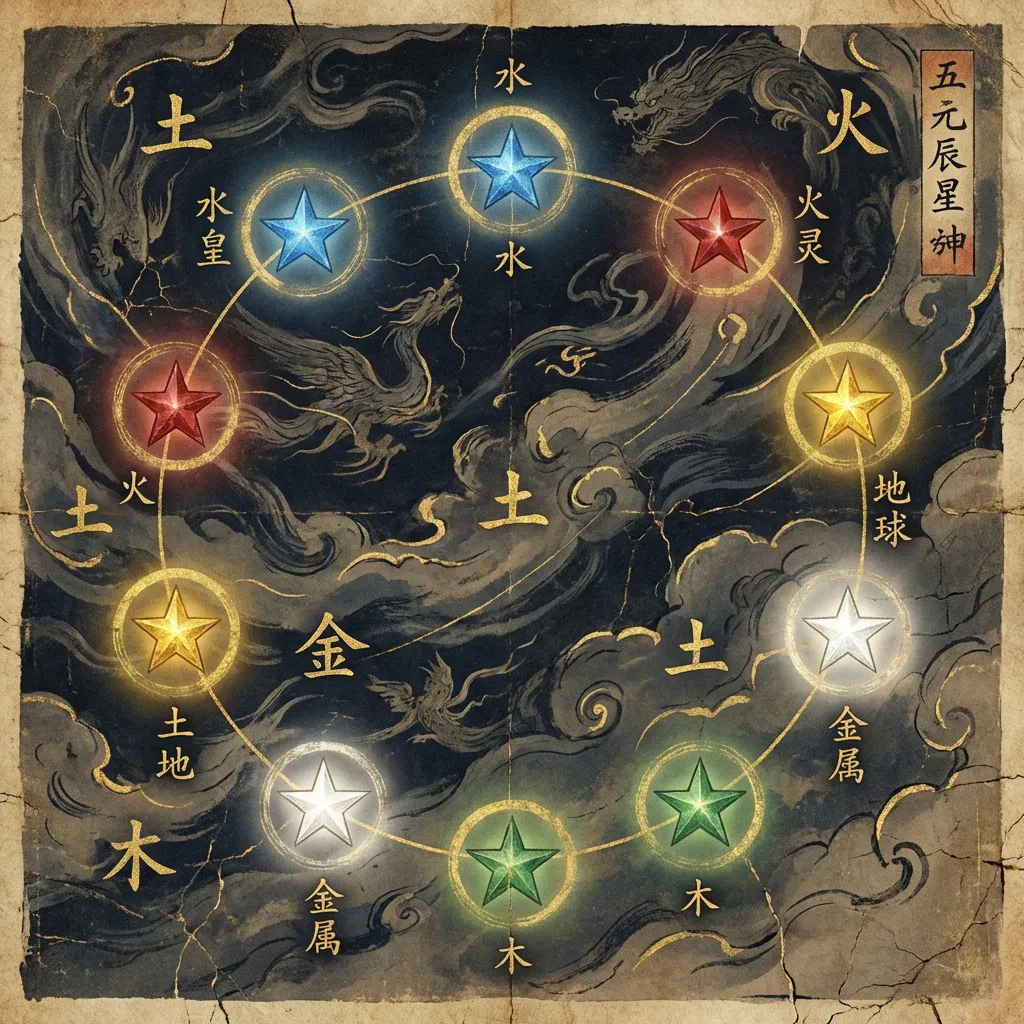
Introduction to the Heavenly Stems
天干 (Tian Gan) literally translates to “Heavenly Stems” or “Celestial Trunks.” They are ten symbols that represent the flow of celestial energy from heaven, each carrying a specific element and polarity (Yin or Yang).
Together with the twelve Earthly Branches, the Heavenly Stems form the sexagenary cycle — a 60-unit cycle (10 x 12 = 60 unique pairs) that has been used in China for over 3,000 years to count years, months, days, and hours. This cycle is the mathematical foundation of every Bazi chart.
In your Bazi reading, each of your four pillars (Year, Month, Day, Hour) has a Heavenly Stem on top and an Earthly Branch on the bottom. Understanding the stems is the first step toward reading the celestial half of your destiny chart.
The Ten Heavenly Stems
The ten stems cycle through all five elements, with each element appearing twice — once as Yang (active, expanding) and once as Yin (receptive, contracting). This pairing reflects the ancient Chinese understanding that every force in nature has two complementary expressions.
🌳 Yang Wood — Stem #1
🌿 Yin Wood — Stem #2
🔥 Yang Fire — Stem #3
🕯️ Yin Fire — Stem #4
🏔️ Yang Earth — Stem #5
🌾 Yin Earth — Stem #6
⚔️ Yang Metal — Stem #7
💎 Yin Metal — Stem #8
🌊 Yang Water — Stem #9
🌧️ Yin Water — Stem #10
Yang vs Yin Polarity
Each element manifests in two polarities. This is not about one being “better” — Yang and Yin are complementary forces that together describe the full spectrum of how an element expresses itself.
Yang Stems
Stems 1, 3, 5, 7, 9 — the odd-numbered stems
- •Active and outward — Yang energy projects itself into the world. Yang people tend to be direct, assertive, and action-oriented.
- •Larger expression — Yang represents the bigger, stronger form of an element. Yang Wood is the tall tree; Yang Fire is the blazing sun.
- •Leadership quality — There is a natural confidence and forcefulness. Can also manifest as stubbornness or inflexibility.
Yin Stems
Stems 2, 4, 6, 8, 10 — the even-numbered stems
- •Receptive and inward — Yin energy absorbs and processes. Yin people tend to be thoughtful, adaptable, and strategic.
- •Subtler expression — Yin represents the smaller, more refined form. Yin Wood is the flexible vine; Yin Fire is the focused candle flame.
- •Diplomatic quality — There is a natural grace and sensitivity. Can also manifest as indecisiveness or over-caution.
Stems in Your Bazi Chart
Every Bazi chart consists of four pillars, and each pillar has two characters: a Heavenly Stem on top and an Earthly Branch on the bottom. This gives you four Heavenly Stems in your chart — one for each pillar.
The Four Pillars Structure
Hour
Day
Month
Year
The Day Stem is your Day Master — the most important element in your entire chart.
The Day Stem (the Heavenly Stem of your Day Pillar) is your Day Master. It represents you — your core identity, personality, and the lens through which you experience life. All other elements in the chart are interpreted in relation to this stem.
The other three stems (Year, Month, Hour) represent different aspects of your life: the Year Stem relates to your grandfather's generation and social image; the Month Stem to your parents and career; and the Hour Stem to your children and late-life prospects.
Stems in different pillars can interact with each other through combinations, clashes, and other relationships, creating the complex tapestry of energy that makes each Bazi chart unique.
The Five Stem Combinations
One of the most fascinating aspects of the Heavenly Stems is their ability to combine. When certain pairs of stems appear together in a chart (typically in adjacent pillars), they can merge to produce the energy of a completely different element. There are exactly five such combinations, each pairing a Yang stem with a Yin stem.
Whether a combination fully transforms depends on the supporting elements and overall chart structure, but even a partial combination influences how those stems behave.
Note: Stem combinations are an advanced topic. A full transformation requires favorable conditions in the chart. In professional Bazi readings, a master will assess whether each combination is “successful” (fully transformed) or “attempted” (partially active). Even an attempted combination softens the original stems' energy and adds the flavor of the resulting element.
Frequently Asked Questions
Continue Learning
Earthly Branches
Discover the twelve Earthly Branches and their zodiac animals that ground celestial energy in earthly time.
Day Master
Your Day Master is the Heavenly Stem of your Day Pillar. Learn what each of the ten Day Masters reveals about you.
What is Bazi?
Start from the beginning and learn about the ancient Chinese system of Four Pillars of Destiny.
Discover Your Bazi Chart
Ready to explore your own Four Pillars of Destiny? Get a personalized AI-powered Bazi reading based on your birth data.
Start My Reading