Introduction
Element compatibility is one of the most popular and practical applications of Bazi. For centuries, Chinese families have consulted Bazi masters to assess the compatibility of potential spouses, and today this analysis extends to all kinds of relationships — romantic partners, business associates, friends, and family members.
At its core, compatibility analysis begins with the Day Master — the Heavenly Stem of your Day Pillar, which represents your true self. By comparing the elements of two people's Day Masters, we can understand the fundamental dynamic of their relationship: does one person's energy naturally support the other? Does it challenge them? Or do they mirror each other?
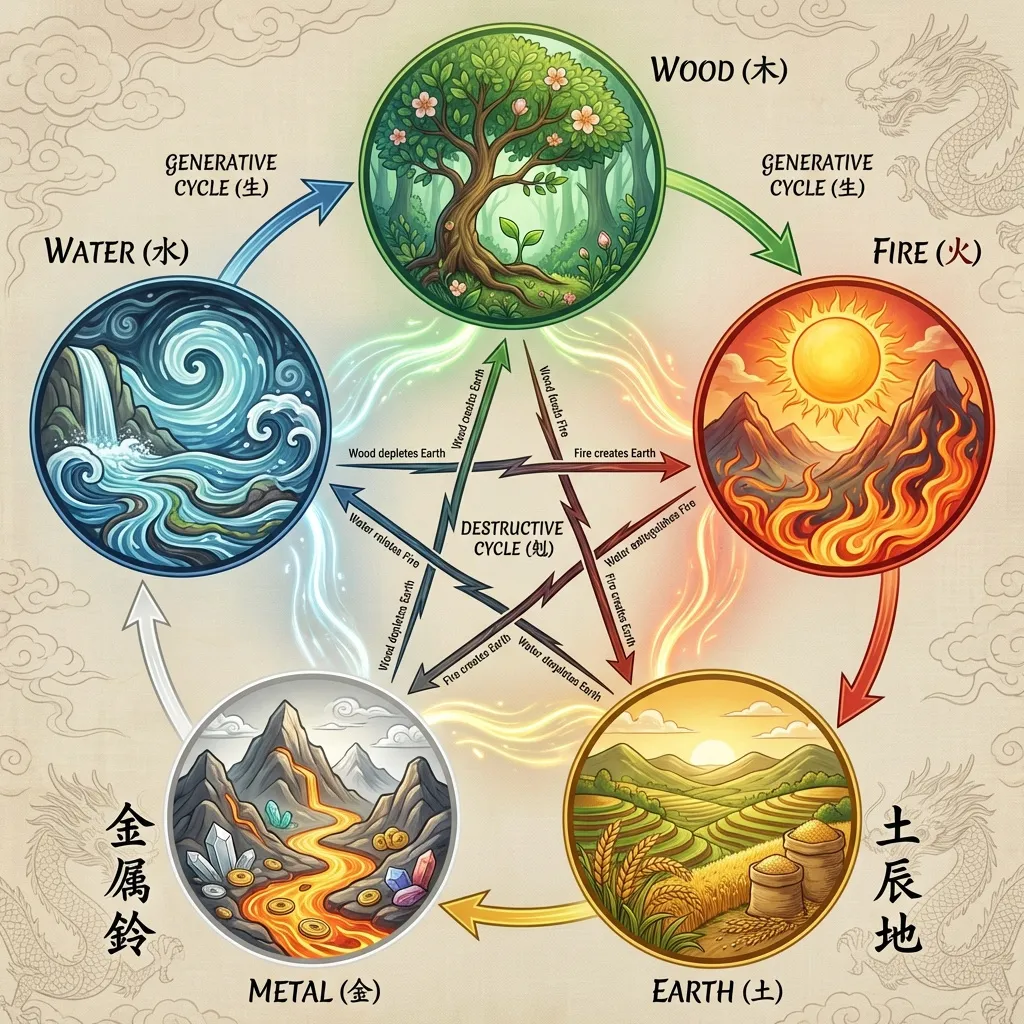
The Five Elements follow two primary cycles that govern compatibility. The Productive Cycle (相生) describes how elements generate and nourish each other. The Controlling Cycle (相克) describes how elements restrain and challenge each other. Neither is inherently good or bad — both are necessary for balance.
Productive Pairings 相生
In a productive pairing, one partner's element naturally generates and supports the other's. This creates a nurturing dynamic where one person feeds energy to the other. The generating partner often takes on a supportive, giving role, while the receiving partner benefits from that nourishment and grows.
While these pairings tend to feel naturally harmonious, awareness is important: the generating partner should ensure they are not depleting themselves, and the receiving partner should appreciate the support rather than taking it for granted.
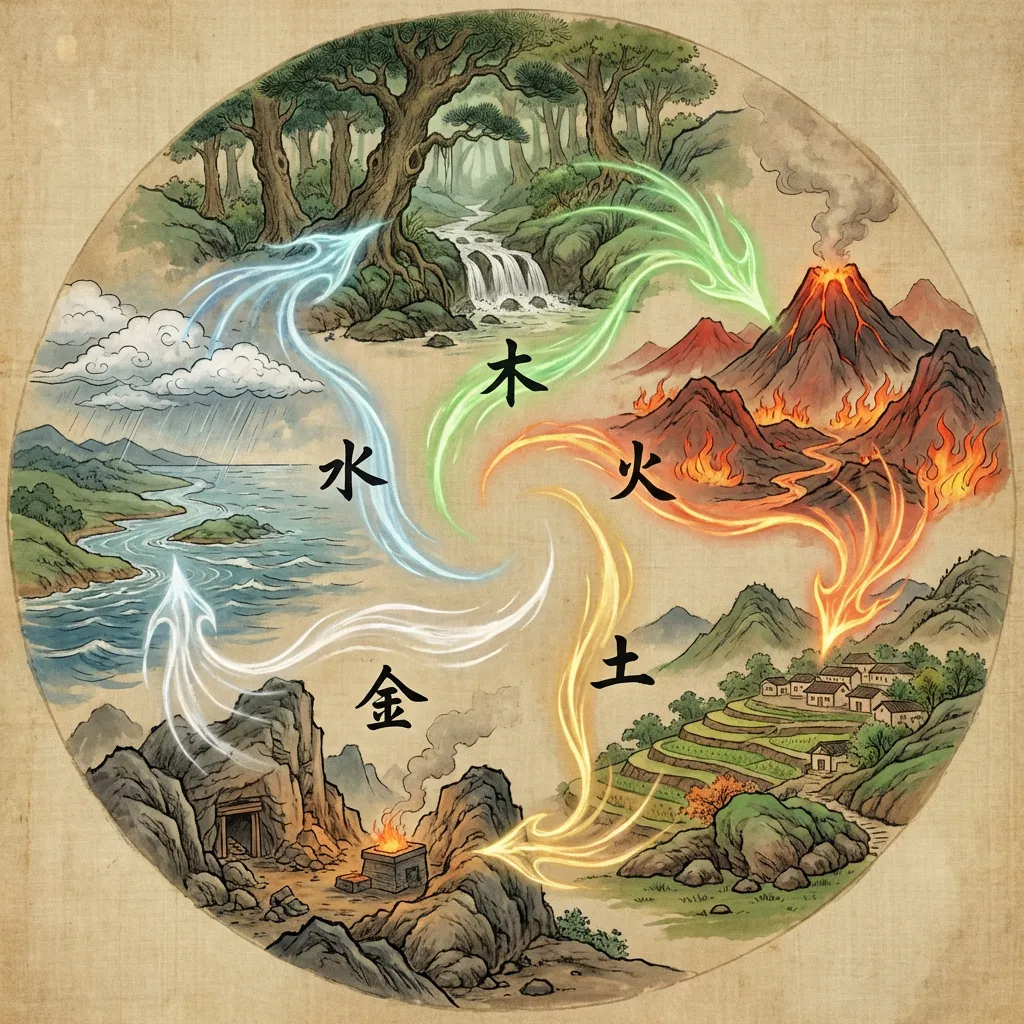
Wood + Fire
Wood fuels Fire. Creative, passionate relationships full of inspiration and energy.
Fire + Earth
Fire creates Earth. Warm, nurturing bonds with deep emotional security and care.
Earth + Metal
Earth produces Metal. Stable, structured partnerships built on trust and reliability.
Metal + Water
Metal holds Water. Clear, supportive connections with intellectual depth and clarity.
Water + Wood
Water nourishes Wood. Growth-oriented relationships focused on development and expansion.
Controlling Pairings 相克
In a controlling pairing, one partner's element naturally restrains or challenges the other's. This does not mean the relationship is doomed — the controlling cycle is a fundamental part of nature and serves an essential purpose. Without control, elements grow unchecked and become destructive.
Controlling pairings often involve more friction and require greater conscious effort to maintain harmony. However, they can also be the most transformative relationships, pushing both partners toward growth that they would not achieve alone.
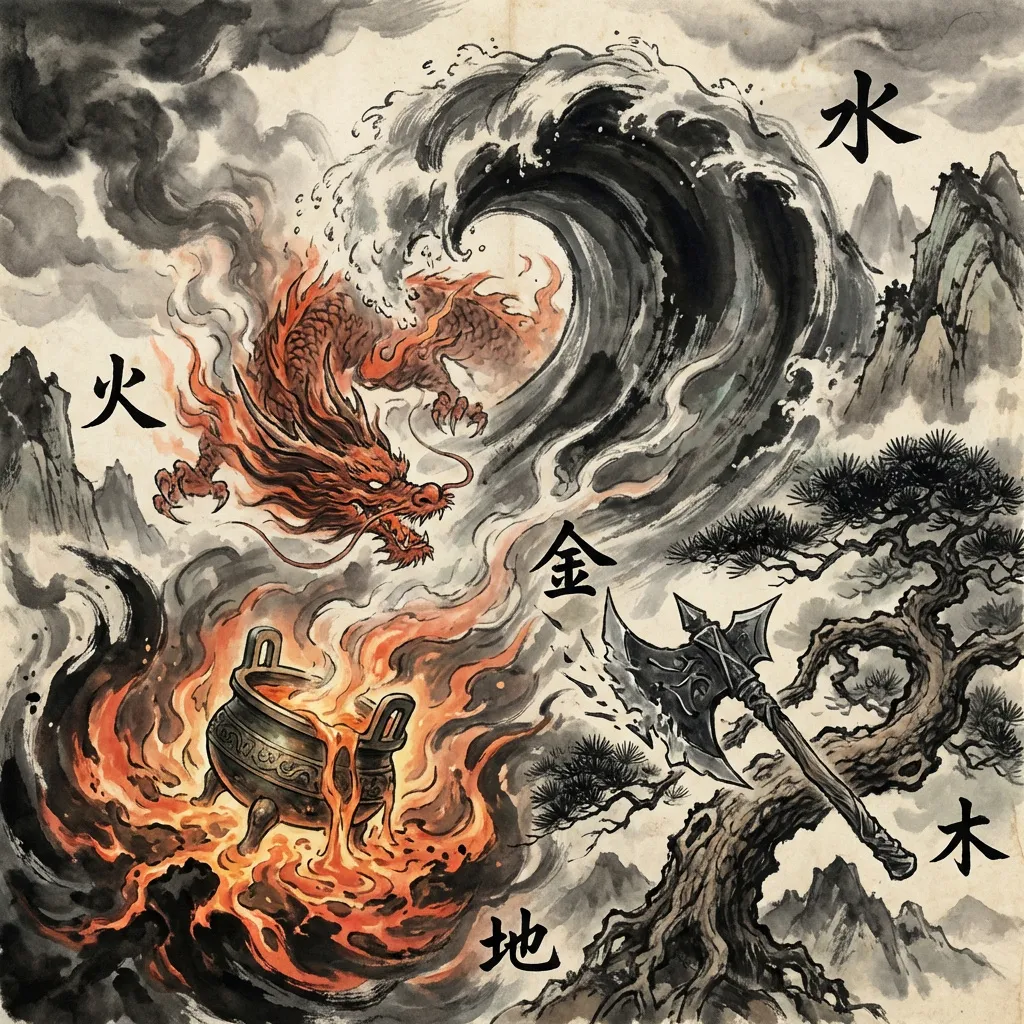
Wood + Earth
Wood controls Earth. Can create power dynamics where one partner dominates direction and decision-making.
Earth + Water
Earth dams Water. May feel restrictive — the Water partner can feel contained or blocked from flowing freely.
Water + Fire
Water extinguishes Fire. Emotional challenges arise as one partner cools the other's passion and enthusiasm.
Fire + Metal
Fire melts Metal. Intense but potentially consuming — the Metal partner may feel overwhelmed by Fire's energy.
Metal + Wood
Metal cuts Wood. Sharp but can be pruning — when constructive, Metal helps Wood grow in better directions.
Important: The controlling cycle is not "bad." In Chinese philosophy, both generation and control are necessary for balance. A world with only productive relationships would lead to unchecked growth, while controlling relationships provide the necessary structure and boundaries for healthy development.
Same Element Pairings
When two people share the same Day Master element, they enter a relationship defined by deep, intuitive understanding — and potential rivalry. Like two fires burning side by side, they share the same warmth, the same fuel source, and the same fundamental nature.
Strengths
- •Instant mutual understanding and recognition
- •Shared values, perspectives, and life approach
- •Natural empathy for each other's struggles
- •Combined strength when working toward shared goals
Challenges
- •Competition for the same resources and recognition
- •Shared blind spots — neither fills the other's gaps
- •Potential power struggles over who leads
- •Amplification of weaknesses as well as strengths
Yin-Yang Balance Within Same Element
Same-element pairings work best when the two people have different polarities — one Yin and one Yang. For example, Yang Wood (甲 Jia) paired with Yin Wood (乙 Yi) combines the sturdy oak with the flexible vine, creating complementary strengths within a shared elemental nature. Two Yang Woods or two Yin Woods are more likely to compete directly.
Beyond the Day Master
While Day Master compatibility provides a powerful first impression of how two people relate, a complete Bazi compatibility analysis goes much deeper. Professional practitioners examine the full eight characters of both charts, looking for patterns that reveal the true complexity of the relationship.
Full Chart Analysis
All eight characters (four Heavenly Stems and four Earthly Branches) of both partners are examined. The elements across both charts are tallied to see if the combined energy creates balance or amplifies existing imbalances. A couple with complementary charts — where one person's missing elements are abundant in the other's — often experiences a deep sense of completion.
Branch Interactions
The Earthly Branches between two charts can form combinations (合), clashes (冲), and other special relationships. When the Day Branch of one person combines with the Day Branch of another, it signals a strong marital connection. Clashes between Day Branches may indicate fundamental friction that requires work to overcome.
Timing Compatibility
Even the best elemental match can face difficulties during challenging luck periods. Bazi compatibility analysis considers both partners' 10-year luck pillars and annual influences to identify periods when the relationship may face strain and when it will thrive. Understanding timing helps couples prepare for challenging periods and make the most of harmonious ones.
Family Dynamics
Element compatibility extends far beyond romantic partnerships. Within a family, the elemental interactions between parents and children, between siblings, and across generations create a complex web of dynamics that shapes family life.
Parent-Child Dynamics
A parent whose element generates the child's element (like Water nurturing Wood) naturally supports that child's growth. A parent whose element controls the child's (like Metal cutting Wood) may need to consciously soften their approach. Understanding these dynamics helps parents adapt their style to each child's elemental needs.
Sibling Dynamics
Siblings with complementary elements often form strong bonds — one naturally supports the other. Siblings with the same element may experience more rivalry. Siblings with controlling relationships may have a more complicated dynamic, but with awareness, these interactions can foster resilience and personal growth.
Creating Family Harmony
Understanding the elemental dynamics within your family does not mean accepting conflict as inevitable. Instead, it provides a framework for understanding why certain family members naturally click while others require more effort. With this awareness, families can:
- •Appreciate each member's unique elemental gifts and perspectives
- •Adjust communication styles to match each person's elemental nature
- •Identify and bridge elemental gaps that cause misunderstanding
- •Leverage complementary strengths for collective family growth
Curious about the elemental dynamics in your family? Our AI-powered family compatibility analysis maps the relationships between all family members.
Explore Family CompatibilityFrequently Asked Questions
Continue Learning
Discover Your Bazi Chart
Ready to explore your own Four Pillars of Destiny? Get a personalized AI-powered Bazi reading based on your birth data.
Start My Reading